

Printed. Sintered. Ridden. 15 Years of Metal 3D Printing in Frame Building
A story about lugs, lasers and sinter ovens — and why a chicken from the Fichtelgebirge was there before almost anyone else.
Where it started: a diploma project in 2011
In December 2011, a track frame appeared on the early 3D printing blogs that looked like nothing else at the time: black carbon tubes, joined by delicate, organically shaped metal lugs that had come straight out of a 3D printer. The frame weighed 1,100 grams, the fork 480 grams. The lugs were generated parametrically — change the rider's dimensions, and the software would reshape the lugs for a completely custom geometry before printing.
That bike was the VRZ 1. I built it as my diploma project, bonding 3D-printed stainless steel lugs to carbon fiber tubes. To my knowledge — and to the knowledge of everyone who has since written about it — it was the first documented bicycle frame that used additive manufacturing for its structural frame construction.
At the time, this was a strange thing to do. Metal 3D printing lived in aerospace labs and dental clinics. Nobody printed bicycle parts. There was no supply chain, no design guidelines, no one to ask. There was just a simple observation: a lugged frame is the perfect architecture for 3D printing, because the complicated geometry sits in small joints while proven tubes do the long, straight work.
Fifteen years later, that observation carries an entire segment of the bicycle industry.
"Don't be surprised if tomorrow your neighbour comes home with a VRZ 1." — 3ders.org, December 2011
The follow-up: VRZ 2 and titanium
Two years later I built the VRZ 2 and the belt-driven VRZ 2 BELT — again carbon tubes, but now with lugs in Ti6Al4V titanium, produced with the LaserCUSING process (what we today call laser powder bed fusion). The VRZ 2 traveled through the design press: Core77 called it "3D-printed bike porn." More importantly, it proved that printed titanium could handle the loads of a real frame, and that custom geometry per rider was not a gimmick but the whole point.


The VRZ 2 BELT: Ti6Al4V lugs, carbon tubes, Gates belt drive — 4.9 kg complete. Pictures by Simon Markhof.
One of the nicest artifacts from that time is an email I still keep: a thank-you note from Bastion Cycles in Australia, who saw the VRZ concept and went on to build their entire company around 3D-printed titanium lugs and carbon tubes. Watching an idea from a small German workshop become a production method on the other side of the planet — no hard feelings, just proof the idea worked.
Fifteen years of printed frames
What happened after 2011 reads like a relay race — from aerospace-printed dropouts to World Cup downhill bikes, hour records and Olympic track parts. The short version:

The processes: how metal actually gets printed
"Metal 3D printing" is not one technology. Over the years HUHN has worked with three fundamentally different process families — and learned their strengths and limits the practical way.

1. Laser Powder Bed Fusion (LPBF / SLM / DMLS)
The classic. A laser melts fine metal powder layer by layer, directly producing a dense metal part. Fully dense parts straight off the machine, aerospace-grade mechanical properties, fine detail — but the machines are extremely expensive and must run around the clock to be economical, support structures cost material and labor, and reactive titanium powder needs strict safety handling. In bikes: the VRZ 2, the steel Moorhuhn's lugs, Empire, Robot Bike Co, Bastion, Atherton.


LPBF in practice: honeycomb structures inside the Moorhuhn lugs, 99.9 % density, integrated cable routing — printed in, not drilled after.
2. Cold Metal Fusion — the sinter-based SLS route
The process behind the titanium Moorhuhn lugs, developed by Headmade Materials (Würzburg) and industrialised by partners like Element22 (Kiel). The feedstock is metal powder where each particle is coated in a polymer binder. A standard polymer SLS machine melts only the binder — at below 80 °C, hence "cold" — producing a strong green part. The binder is then removed and the part is sintered into solid metal.
The advantages are substantial: it runs on affordable polymer SLS machines; during printing the loose powder bed carries the part, and the sinter supports are co-printed in the same job — their contact surfaces get a ceramic coating so part and support don't bond during sintering, and the supports come off cleanly instead of being machined off. Titanium powder is bound in polymer so handling is dramatically safer, unused powder is recycled, and mechanical properties are comparable to metal injection moulding. The price: debinding and sintering demand real know-how, and sinter shrinkage must be designed in from the start.


Cold Metal Fusion titanium lugs for the Moorhuhn 129 Ti, fresh from the sinter oven — as-sintered surface, printed by Element22 with Headmade's process.
3. Metal FFF — BASF Ultrafuse 17-4 PH filament
The most accessible route of all — and the one that made the Jersey Giant possible. A filament with more than 80 % metal content (17-4 PH stainless steel bound in polymer) is printed on an ordinary desktop FFF printer — in our case Ultimaker machines. The printed green part then goes through catalytic debinding and sintering: green → brown → metal.
Parts are printed oversized because they shrink during sintering — roughly 16 % in the XY plane and around 20 % in Z. Designing a structural lug means designing its shrunken future. The entry cost is a fraction of any other metal AM route — a print farm of desktop machines instead of a million-euro laser system — which makes it ideal for distributed, local small-series production. The challenge: sintering distortion for large or asymmetric parts, and every part needs its own sinter-support strategy.


Three HUHN projects, three processes
Moorhuhn (2020) — steel, LPBF lugs
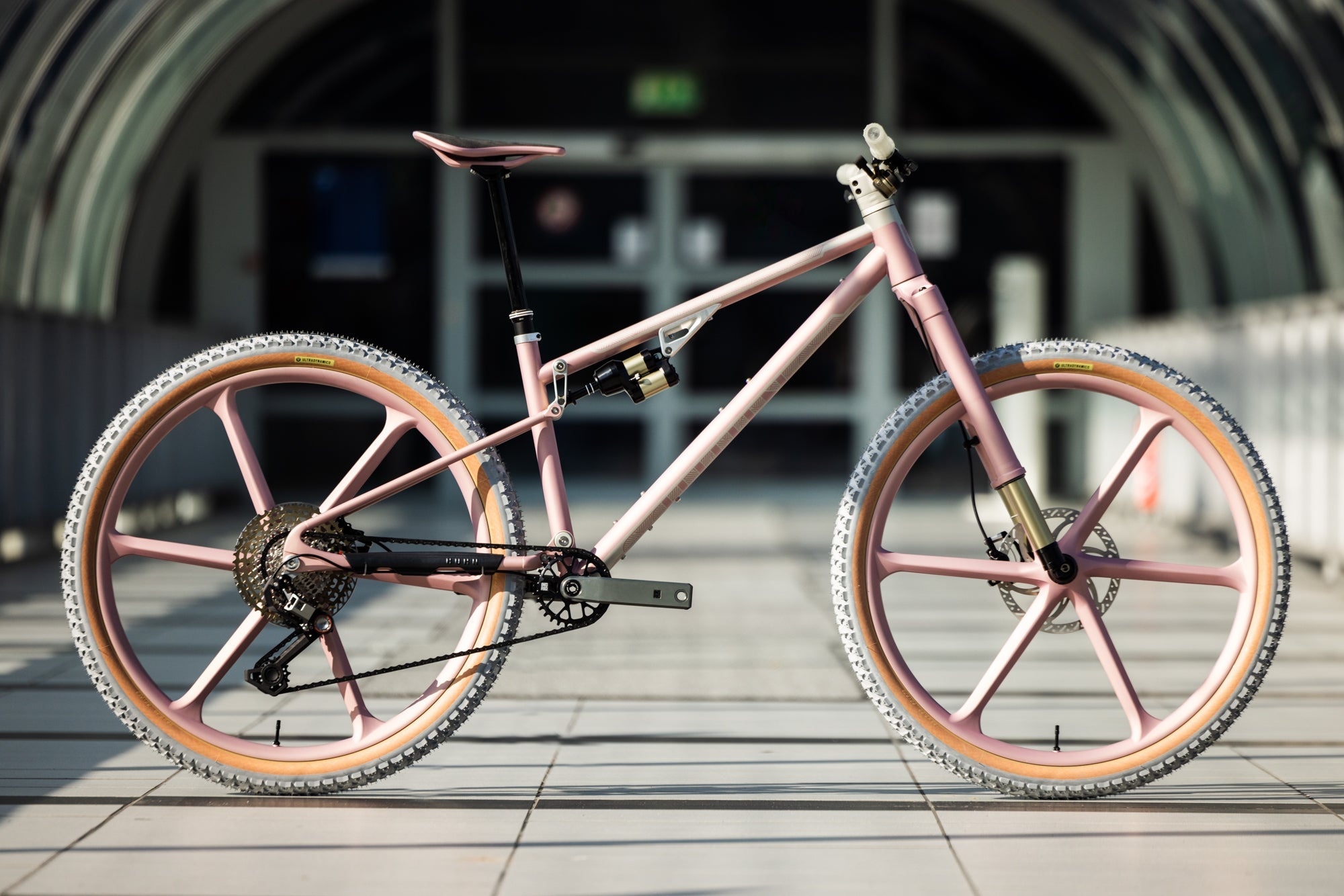
The bike that asked: can steel be sexy again? 129 mm of travel from a simple, serviceable single pivot with shock extension, a Reynolds 953 front triangle, Columbus Zona rear, and laser powder-bed printed stainless lugs with honeycomb internals. Polished to a near-mirror finish, chromovelato top tube — and suddenly half the bike internet had an opinion about steel. Winner of the Purmundus Challenge 2020 and first place in the European Bike Challenge.


Moorhuhn 129 Ti (2022) — titanium, Cold Metal Fusion lugs
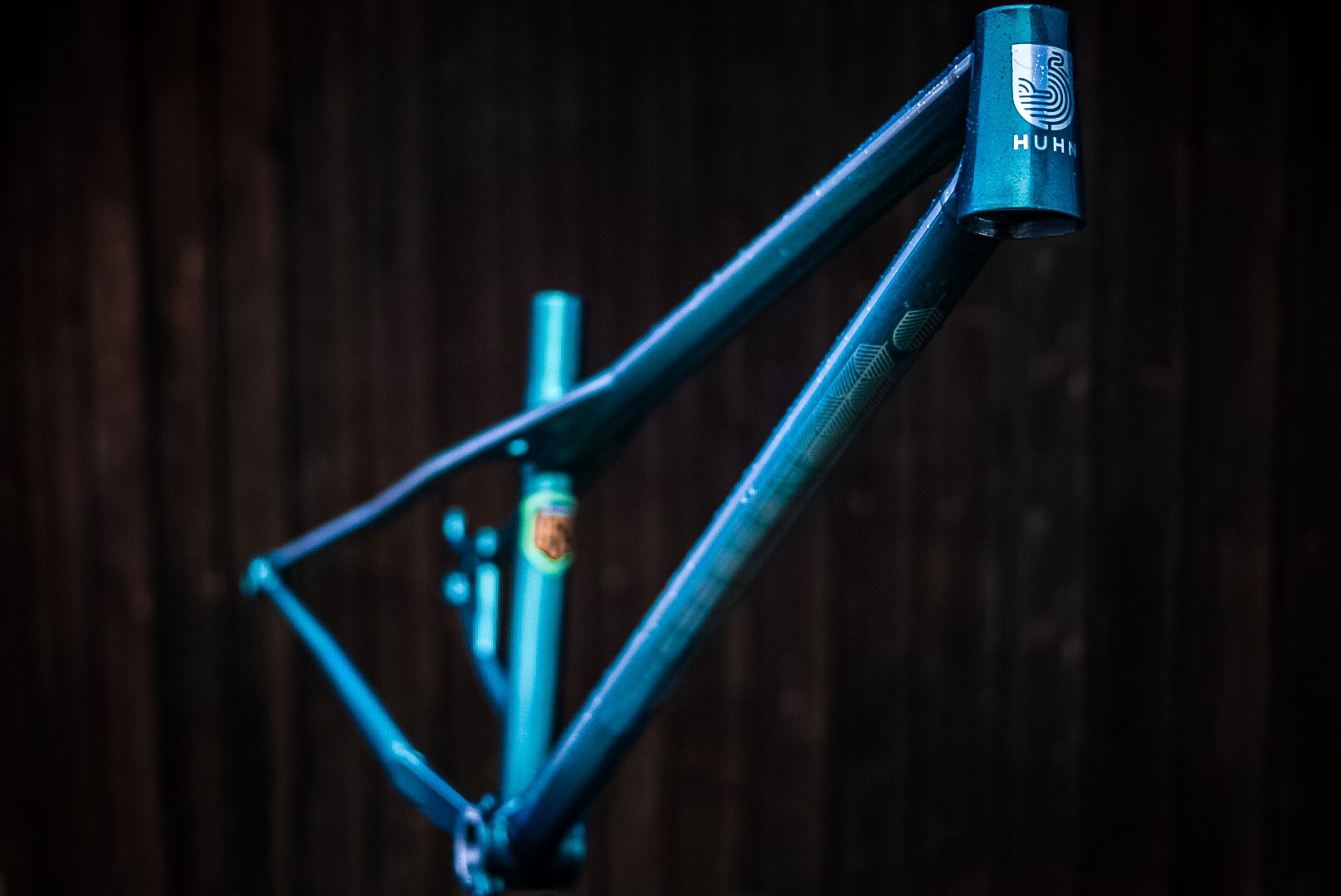
The same platform, rebuilt in titanium: Ti-6Al-4V lugs, Grade 9 front triangle, Grade 2 swingarm, tubes by Dedacciai, welded together with Mathias Scherer of Mawis Bikes. A full kilogram lighter than steel, no paint needed — anodized, masked with feather-shaped stickers and sandblasted instead. A chicken gets its feathers back.


Jersey Giant (2022) — steel, metal FFF lugs
A 36-inch wheeled bike for Tim, 2.06 m tall, built with Tim Ahnsorge and Hahn Rossman. The lugs came off desktop Ultimaker printers in Ultrafuse 17-4 PH, were sintered into solid stainless steel and brazed to Reynolds 853 tubes made from recycled steel. To our knowledge the first bicycle whose structural frame parts were made with metal filament printing. New Builder Award at Bespoked 2022 in London.


Why lugs? The design logic behind every HUHN
Across all these processes, HUHN has stayed loyal to one architecture: printed junctions, proven tubes.
A bicycle frame is mostly straight lines — and drawn tubes are a nearly perfect product: consistent, light, tough, affordable. The complexity lives at the joints, where five tubes meet a shock mount at compound angles. Printing exactly there — and only there — means custom geometry without tooling, batch economics (many small lugs nest into one build job), honest engineering (the printed part stays visible and readable), serviceability (steel tubes can be replaced, brazed and repaired for decades) and genuinely local production: powder and filament from Germany, tubes from the UK and Italy, sintering in Kiel or Würzburg, brazing and finishing in the Fichtelgebirge.

This is what additive manufacturing is actually for in bicycle building. Not printing entire frames because it's possible — but putting complexity precisely where it earns its keep. The CHABO — our steel full-suspension trail bike and Best MTB at Bespoked Dresden 2024 — and the La Fleche hardtail with its 3D-printed lugs both carry this logic into series production.
What's next
Fifteen years in, metal 3D printing in cycling has grown from one glued-together diploma bike into World Cup downhill bikes, hour records, Olympic track parts and quiet, reliable series production in small workshops. The frontier is shifting from "can it be printed?" to "where does printing genuinely make the better product?"
At HUHN, the answer stays the same as in 2011: use the printer where geometry, fit and function demand it. Use steel and proven tubes everywhere else. Build bikes that can be ridden hard, serviced forever and inherited.

Questions about printed lugs, custom geometry or any of the processes? Get in touch — we genuinely like talking about this stuff.
Sources: 3ders.org (2011) · Core77 (2013) · Renishaw & Guinness World Records (2014) · road.cc (2015) · BikeRadar & Pinkbike (2016) · Singletrack & Pinkbike (2020) · off-road.cc (2020) · BIKE Magazin (2022) · MTB-News (2022) · Headmade Materials / Element22 · BASF Forward AM · Renishaw (2019) · BikeRadar (2022, 2025) · RAM3D · Stefanus Bosch, Craft Bike Days 2022.